
In our first article, we spoke about the foundation of Artificial Intelligence — data, models, and deployment.
But once organisations begin their AI journey, a new challenge quickly appears:
Which AI model should we actually use?
Today’s AI landscape can feel overwhelming.
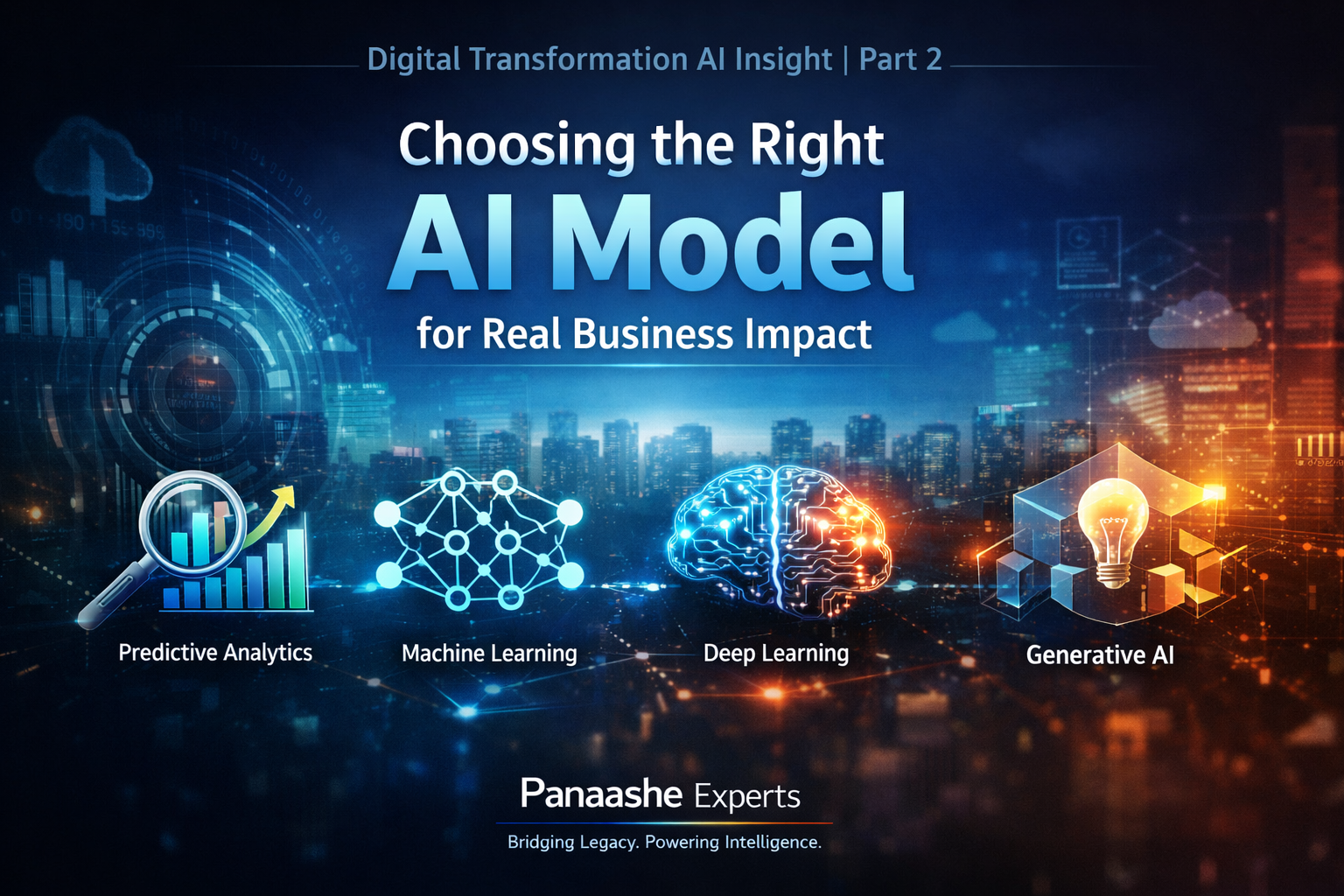
Predictive models.
Machine learning algorithms.
Deep learning systems.
Generative AI tools.
Every platform promises intelligence.
Every vendor claims transformation.
But the reality is simple.
The best AI model is not the most advanced one.
It is the one that solves your business problem.
AI Should Start with the Problem — Not the Model
One of the most common mistakes organisations make is beginning their AI journey by exploring technology.
Instead, the starting point should always be the business objective.
For example:
If a retail company wants to predict customer demand, predictive analytics models are often the right fit.
If a bank needs to detect suspicious transactions, machine learning classification models become critical.
If a manufacturing plant wants to predict equipment failures, anomaly detection models can create real value.
And if a company wants to automate content creation or customer interactions, generative AI models may provide the right solution.
The key is alignment.
Technology should serve the business problem — not the other way around.
Understanding the Major AI Model Categories
While there are hundreds of algorithms, most business AI applications fall into a few broad categories.
Predictive Models
Predictive models analyse historical data to forecast future outcomes.
Businesses use these models for:
-
Demand forecasting
-
Customer churn prediction
-
Sales projections
-
Risk analysis
Predictive AI helps organisations move from reactive decisions to proactive planning.
Machine Learning Models
Machine learning allows systems to learn patterns from data without explicit programming.
Common applications include:
-
Fraud detection
-
Recommendation engines
-
Customer segmentation
-
Personalised marketing
These models improve continuously as more data becomes available.
Deep Learning Models
Deep learning is a more advanced subset of machine learning that works well with complex data such as images, speech, and large datasets.
Industries apply deep learning for:
-
Medical imaging analysis
-
Autonomous systems
-
Voice recognition
-
Large-scale pattern detection
While powerful, deep learning requires significant data and computing resources.
Generative AI Models
Generative AI has recently captured global attention.
These models can generate new content including text, images, code, and even design concepts.
Businesses are exploring generative AI for:
-
Customer support automation
-
Content generation
-
Knowledge assistants
-
Software development support
However, generative AI also introduces important considerations around accuracy, governance, and ethical use.
Why Model Selection Must Consider More Than Technology
Choosing an AI model is not only a technical decision.
It is also a strategic one.
Several factors influence the right approach:
Data availability
Without reliable data, even advanced models fail.
Business objective clarity
The clearer the problem definition, the better the AI outcome.
Integration with existing systems
AI must work alongside legacy platforms and enterprise applications.
Cost and scalability
Some models require heavy computing infrastructure.
Governance and compliance
Responsible AI practices are becoming essential across industries.
This is why organisations should approach AI implementation with a structured framework rather than experimentation alone.
The Role of Cloud Platforms in AI Model Deployment
Today, major cloud providers offer extensive AI ecosystems.
Platforms such as AWS, Microsoft Azure, and Google Cloud provide pre-built tools for:
-
Model development
-
Data processing
-
AI deployment
-
Monitoring and scaling
These platforms reduce the barrier to entry for organisations exploring AI.
However, selecting the right platform depends on:
-
Existing enterprise systems
-
Security requirements
-
Cost structure
-
Integration complexity
Technology decisions should always support long-term operational stability.
A Strategic Approach to AI Adoption
For organisations navigating AI adoption, a structured approach often works best:
-
Define the business problem clearly
-
Assess data readiness
-
Select the appropriate AI model
-
Test with a focused pilot
-
Deploy responsibly and scale gradually
AI success rarely happens overnight.
It emerges from careful experimentation, governance, and continuous learning.
What This Means for Industry Leaders
Artificial Intelligence is not simply a technology upgrade.
It represents a shift in how organisations make decisions.
Companies that treat AI as a strategic capability — not just a tool — will build stronger competitive advantage.
But success requires balance.
Innovation must be paired with responsibility.
Speed must be matched with governance.
And new technologies must integrate with existing enterprise systems.
What’s Next in This Series
In the next article of our Digital Transformation AI Insight series, we will explore:
How different industries — including healthcare, finance, retail, and manufacturing — are applying AI today to create real business value.
Because understanding technology is only the first step.
Seeing how it transforms industries is where the real insight begins.
Panaashe Experts
Bridging Legacy. Powering Intelligence.